
15 KiB
Roadmap
This document describes the current state of Iced and some of the most important next steps we should take before it can become a production-ready GUI library.
Context
Before we get into the actual roadmap, let's quickly review what is the current state of the library.
Users
Iced is meant to be used by 2 different types of users:
- End-users. They should be able to:
- get started quickly,
- have many widgets available,
- keep things simple,
- and build applications that are maintainable and performant.
- GUI toolkit developers / Ecosystem contributors. They should be able to:
- build new kinds of widgets,
- implement custom runtimes,
- integrate existing runtimes in their own system (like game engines),
- and create their own custom renderers.
Current state
Iced consists of different crates which offer different layers of abstractions for our users. This modular architecture helps us keep implementation details hidden and decoupled, which should allow us to rewrite or change strategies in the future.
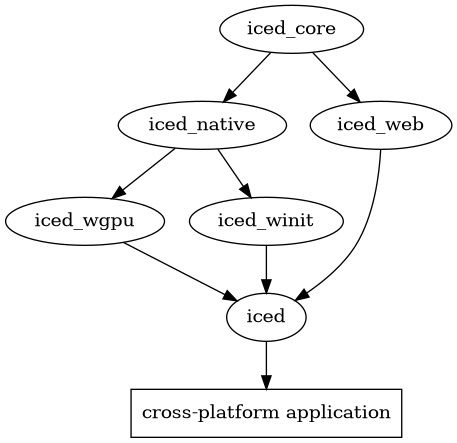
iced_core
iced_core holds most of the reusable types of the public API. For instance, common widgets (like Column, Row, Button...) and basic data types (Point, Rectangle, Length...).
This crate is meant to be a starting point for an Iced runtime.
iced_native
iced_native takes iced_core and builds a native runtime on top of it, featuring:
- A flexbox-based layout engine, powered by
stretch - Event handling for all the built-in widgets
- A renderer-agnostic API
To achieve this, it introduces a bunch of reusable interfaces:
- A
Widgettrait, which is used to implement new widgets: from layout requirements to event and drawing logic. - A bunch of
Renderertraits, meant to keep the crate renderer-agnostic. - A
Windowedtrait, which can be implemented by graphical renderers that target windows. Window-based runtimes can use this trait to stay renderer-agnostic.
iced_web
iced_web takes iced_core and builds a WebAssembly runtime on top. It achieves this by introducing a Widget trait that can be used to produce VDOM nodes.
The crate is a quite simple abstraction layer over dodrio.
iced_wgpu
iced_wgpu is a wgpu renderer for iced_native. It is meant to become the default renderer of Iced in native platforms.
wgpu supports most modern graphics backends: Vulkan, Metal, DX11, and DX12 (OpenGL and WebGL are still WIP). Additionally, it will support the incoming WebGPU API.
Currently, iced_wgpu only supports a couple of primitives:
- Text, which is rendered using
wgpu_glyph. - Quads or rectangles, with rounded borders and a solid background color.
iced_winit
iced_winit offers some convenient abstractions on top of iced_native to quickstart development when using winit.
It exposes a renderer-agnostic Application trait that can be implemented and then run with a simple call. The use of this trait is optional. A conversion module is provided for users that decide to implement a custom event loop.
iced
Finally, iced unifies everything into a simple abstraction to create cross-platform applications:
- On native, it uses
iced_winitandiced_wgpu. - On web, it uses
iced_web.
This is the crate meant to be used by end-users.
Next steps
This section describes some important features that should be implemented before Iced can be considered production-ready (before a 1.0 release).
Most of the work related to these features needs to happen in the iced_native path of the ecosystem, as the web already supports many of them.
Scrollables / Clippables
Content that can take a (practically) infinite amount of space and can be viewed using a scrollbar. This is a very basic feature.
The end-user API could look like this:
Column::new()
    .push(content)
    .scroll(&mut self.scroll_state);
The challenge here is composability. Nested scrollables should work as expected.
When it comes to iced_native, we may need to add the concept of event propagation, so mouse wheel events can be captured by the inner-most scrollable and stop propagation.
When it comes to iced_wgpu, we should be able to use scissoring and transformations. wgpu has a RenderPass::set_scissor_rect that should work nicely.
The main issue here will be wgpu_glyph, which is used currently to render text primitives. wgpu_glyph is powered by glyph-brush, which caches glyphs to render text very fast. However, the current cache model does not seem to be composable (i.e. once you issue a draw call the cache is purged). We will need to change it (and potentially contribute) to accomodate for this use case.
Text input widget
A widget where the user can type raw text and passwords.
This widget will have a quite complex event logic, potentially coupled with text rendering. Some examples are:
- Text cursor positioning based on a mouse click
- Text selection
- Clipboard interaction (copy & paste)
- Text editing shortcuts (go to start, go to end, etc.)
It also needs scrollable / clippable text support, as the introduced text may not fit the input and scrolling based on the text cursor will need to be implemented.
Additionally, the text cursor should blink at a regular interval, which can be considered an animation.
I think we should start simple here, and build a text widget with the most basic functionality: click to focus and type to fill. We can improve the implementation with time as the library matures.
The end-user API could look like this:
pub enum Message {
    TextChanged(String),
}

let text_input = text_input::State::new();
let text = "Hello";

TextInput::new(&mut text_input, &text, Message::TextChanged);
TodoMVC example
Once we have scrollables support and a text widget, we could build a TodoMVC example. It seems to be a very simple example and could showcase the API quite well.
We could also consider releasing a 0.1.0 version at this point and share it as a milestone on different social platforms.
Multi-window support
Open and control multiple windows at runtime.
I think this could be achieved by implementing an additional trait in iced_winit similar to Application but with a slightly different view method, allowing users to control what is shown in each window.
This approach should also allow us to perform custom optimizations for this particular use case.
Async actions
Most applications need to perform work in the background, without freezing the UI while they work. The current architecture can be easily extended to achieve this.
We can let users return an asynchronous action (i.e. a future) producing a Message in Application::update. The runtime will spawn each returned action in a thread pool and, once it finishes, feed the produced message back to update. This is also how Elm does it.
When it comes to implementing this, winit already supports user-specific events that can be sent from another thread. Accomodating iced_winit for this functionality should not be too complicated.
Here is an example of how the end-user API could look:
impl Application for WeatherReport {
    fn update(&mut self, message: Message) -> Command<Message> {
        match message {
            Message::Refresh => {
                self.state = State::Loading;

                Command::from_future(
                    Weather::request(self.location),
                    Message::ReportReceived,
                )
            }
            Message::ReportReceived(Ok(report)) => {
                self.state = State::Show(report);

                Command::none()
            },
            Message::ReportReceived(Err(error)) => {
                self.state = State::Error(error);

                Command::none()
            }
        }
    }
}
Event subscriptions
Besides performing async actions on demand, most applications also need to listen to events passively. An example of this could be a WebSocket connection, where messages can come in at any time.
The idea here is to also follow Elm's footsteps. We can add a method subscriptions(&self) -> Subscription<Message> to Application and keep the subscriptions alive in the runtime.
The challenge here is designing the public API of subscriptions, so users can build their own, and subscription diffing, or basically detecting when a subscription is added/changed/removed. For this, we can take a look at the source code of Elm for inspiration.
Layers
Currently, Iced assumes widgets cannot be laid out on top of each other. We should implement support for multiple layers of widgets.
This is a necessary feature to implement many kind of interactables, like dropdown menus, select fields, etc.
iced_native will need to group widgets to perform layouting and process some events first for widgets positioned on top.
iced_wgpu will also need to process the scene graph and sort draw calls based on the different layers.
Animations
Allow widgets to request a redraw at a specific time.
This is a necessary feature to render loading spinners, a blinking text cursor, GIF images, etc.
winit allows controlling the event loop in a flexible way. We may be able to use ControlFlow::WaitUntil for this purpose.
Canvas widget
A widget to draw freely in 2D or 3D. It could be used to draw charts, implement a Paint clone, a CAD application, etc.
As a first approach, we could expose the underlying renderer directly here, and couple this widget with it (wgpu for now). Once wgpu gets WebGL or WebGPU support, this widget will be able to run on web too. The renderer primitive could be a simple texture that the widget draws to.
In the long run, we could expose a renderer-agnostic abstraction to perform the drawing.
Text shaping and font fallback
wgpu_glyph uses glyph-brush, which in turn uses rusttype. While the current implementation is able to layout text quite nicely, it does not perform any text shaping.
Text shaping with font fallback is a necessary feature for any serious GUI toolkit. It unlocks support to truly localize your application, supporting many different scripts.
The only available library that does a great job at shaping is HarfBuzz, which is implemented in C++. skribo seems to be a nice HarfBuzz wrapper for Rust.
This feature will probably imply rewriting wgpu_glyph entirely, as caching will be more complicated and the API will probably need to ask for more data.
Grid layout and text layout
Currently, iced_native only supports flexbox items. For instance, it is not possible to create a grid of items or make text float around an image.
We will need to enhance the layouting engine to support different strategies and improve the way we measure text to lay it out in a more flexible way.
Ideas that may be worth exploring
Reuse existing 2D renderers
While I believe wgpu has a great future ahead of it, implementing iced_wgpu and making it performant will definitely be a challenge.
We should keep an eye on existing 2D graphic libraries, like piet or pathfinder, and give them a try once/if they mature a bit more.
The good news here is that most of Iced is renderer-agnostic, so changing the rendering strategy, if we deem it worth it, should be really easy. Also, a 2D graphics library will expose a higher-level API than wgpu, so implementing a new renderer on top of it should be fairly straightforward.
Remove explicit state handling and lifetimes
Currently, iced_native forces users to provide the local state of each widget. While this could be considered a really pure form of describing a GUI, it makes some optimizations harder because of the borrow checker.
The current borrow checker is not able to detect a drop was performed before reassigning a value to a mutable variable. Thus, keeping the generated widgets in Application::view alive between iterations of the event loop is not possible, which forces us to call this method quite often. unsafe could be used to workaround this, but it would feel fishy.
We could take a different approach, and keep some kind of state tree decoupled from the actual widget definitions. This would force us to perform diffing of nodes, as the widgets will represent the desired state and not the whole state.
Once the state lifetime of widgets is removed, we could keep them alive between iterations and even make Application::view take a non-mutable reference. This would also improve the end-user API, as it will not be necessary to constantly provide mutable state to widgets.
Improve style definitions
As of now, each widget defines its own styling options with methods, following the builder pattern.
A unified way of defining and reusing styles would be great. I am not proposing something like CSS, we should try to stay as type-safe and intuitive as possible.
I think elm-ui could serve as an inspiration.
Try a different font rasterizer
wgpu_glyph depends indirectly on rusttype. We may be able to gain performance by using a different font rasterizer. fontdue, for instance, has reported noticeable speedups.
Connect iced_web with web-view
It may be interesting to try to connect iced_web with web-view. It would give users a feature-complete renderer for free, and applications would still be leaner than with Electron.
Implement a lazy widget
Once we remove state lifetimes from widgets, we should be able to implement a widget storing a function that generates additional widgets. The runtime would then be able to control when to call this function and cache the generated widgets while some given value does not change.
This could be very useful to build very performant user interfaces with a lot of different items.
Build a custom layout engine
It may be possible to build an optimized layout engine only for iced_native if it turns out that there are some flexbox features we end up not using.